Women in Esports: Breaking Barriers in Competitive Gaming
What Challenges Women in Esports Face?

Content
Three decades into competitive gaming's evolution, here's what hasn't changed: women still make up less than 10% of professional players. Skill matters, obviously—but it's never been the only thing that matters. Female esports players face hurdles their male counterparts simply don't encounter: different harassment levels, unequal sponsorship deals, and team cultures that weren't built with them in mind.
Look back at how we got here, though, and you'll find women competing at the highest levels since before "esports" was even a term people used.
How Women Shaped Early Competitive Gaming (1990s–2010s)
Back in 1994, nobody separated tournaments by gender. The Sega Mega Drive Championship in San Francisco just invited players—period. Amy Finley walked away with $50 after winning a Street Fighter II bracket that year. Not exactly life-changing money, but it established something important: women could win when given the chance to compete.
LAN parties exploded in the late '90s. Cyber cafes became the training grounds where local scenes developed. Kornelia "Karma" Takács showed up to Quake tournaments and held her own against anyone. The infrastructure supporting women? Pretty much nonexistent. Gaming spaces skewed heavily male. Sponsorships barely existed for anyone, and what little money there was went to men.
South Korea's StarCraft scene professionalized faster than anywhere else, hitting full stride by 2000. Still, you could count the women competing on one hand. Then Seo "Tossgirl" Ji-Soo earned professional status through the Korean e-Sports Association in 2004—the first woman to do so. People respected her mechanics. Her game sense was sharp. But she never got the practice time, team resources, or coaching support that standard male pros received.

Author: Brandon Hayes;
Source: quantumcatanimation.com
Around 2004, Ubisoft tried something different: they created the Frag Dolls, the first corporate-sponsored all-female team. Some people called it segregation disguised as opportunity. Others pointed out these women were actually getting paid to play, which put them ahead of 99% of players regardless of gender. Both perspectives had merit.
Counter-Strike 1.6 gave us players like Marija "Minna" Matic and Kat "Mystik" Gunn, who jumped between mixed and women's divisions throughout the 2000s. Gunn's 2008 Championship Gaming Series win even landed her in Guinness World Records. That entire league folded shortly after, unfortunately, taking one of the few stable competitive paths with it.
League of Legends launched in 2009 and eventually became the planet's most-played game. Its professional scene developed with almost zero female representation, though. The handful of women who climbed to challenger ranks typically chose streaming over team contracts. The math was straightforward: streaming paid better and involved substantially less harassment.
5 Systemic Barriers Female Esports Players Face Today
Harassment and Toxicity at Scale
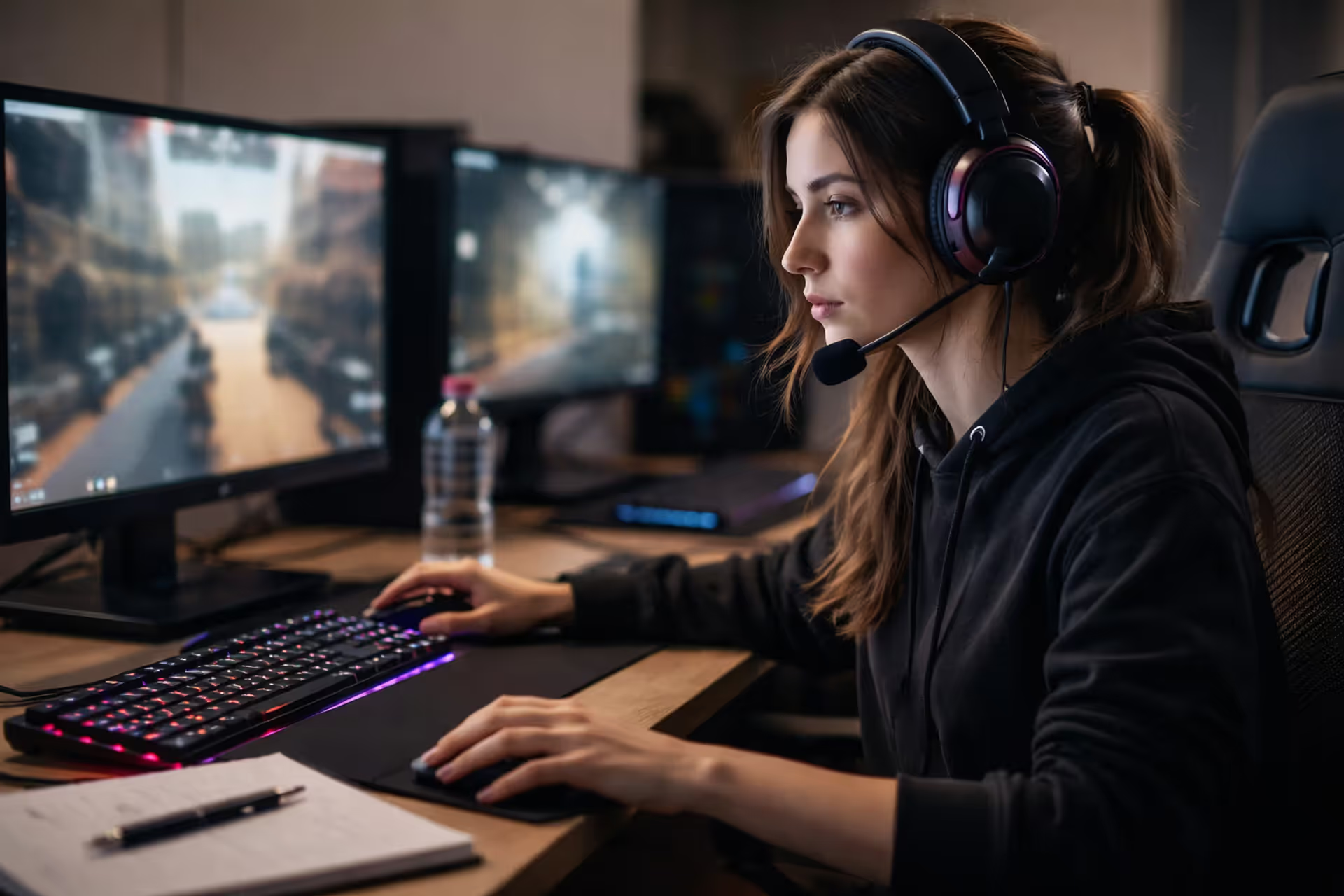
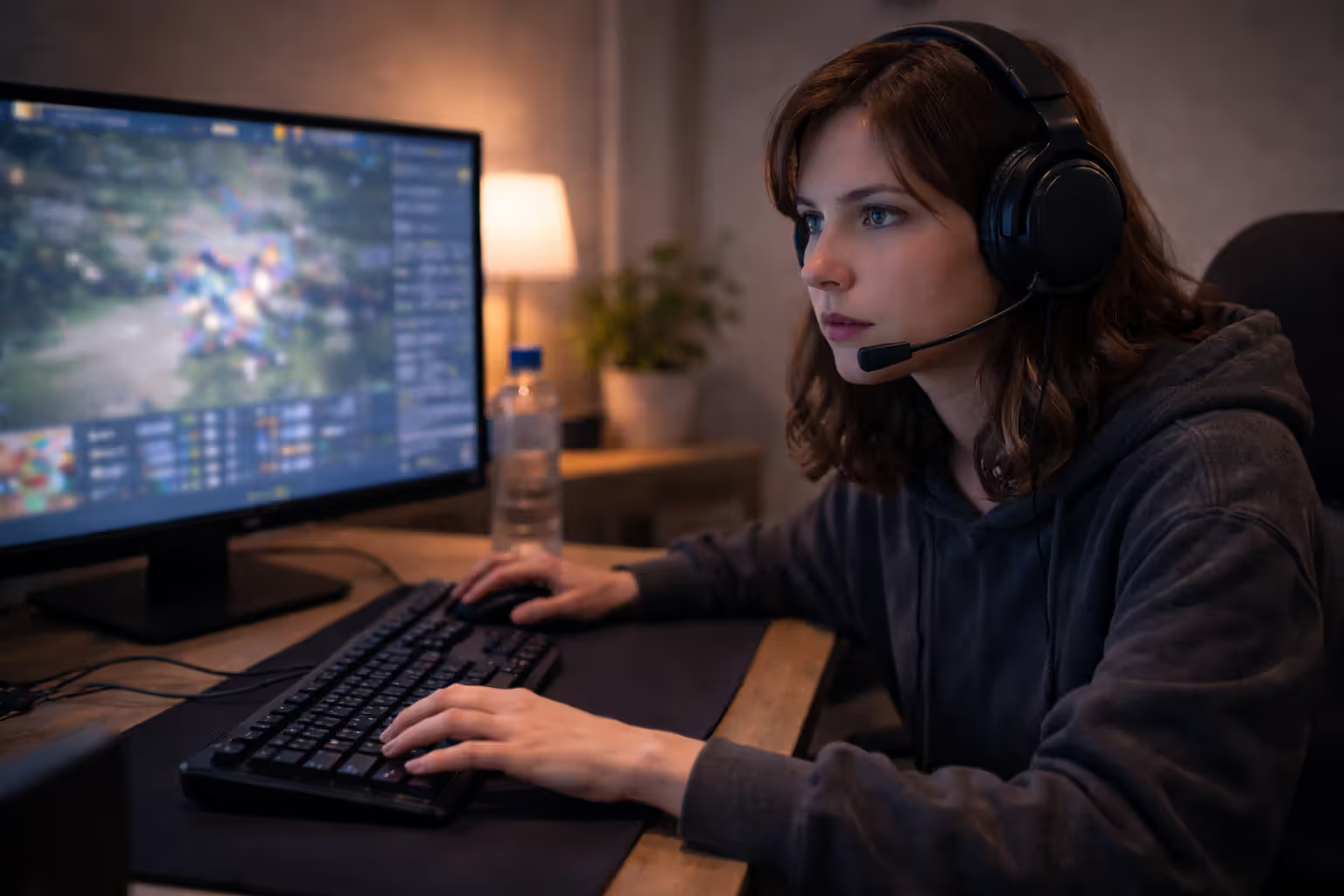
Use voice chat as a woman, and you're rolling the dice every match. A 2023 study tracked 1,200 competitive games and found that feminine voices received targeted harassment 64% of the time. Masculine voices discussing identical topics? Just 11%.
This isn't about developing thicker skin. It's about practice quality. Male players can focus entirely on improvement. Female players split their attention between gameplay and managing toxicity. Many stay silent in solo queue, use voice changers, or only speak with verified teammates. Over thousands of practice hours, that cognitive burden compounds into a measurable disadvantage.
Author: Brandon Hayes;
Source: quantumcatanimation.com
Sponsorship and Salary Disparities
Major organizations field women's rosters now, sure. Check the actual budgets, though. Female players typically earn 40-60% of what male teammates make for comparable performance. Sponsorship activation tells the same story—bigger budgets for men's teams, more prominent campaign features, higher contract renewals.
The excuse? ROI and viewership numbers. Which creates this perfect circle: lower investment means lower visibility, which sponsors cite to justify continued lower investment. Breaking out requires organizations willing to eat short-term losses for long-term market development.
Visibility and Media Coverage Gaps
Broadcast segments, highlight packages, feature articles—they overwhelmingly showcase male players. When women do get coverage, it often emphasizes the "barrier-breaking" angle or focuses on appearance rather than strategic depth. That framing positions female competitors as novelties instead of, you know, competitors.
Tournament organizers face a real dilemma here. If female players rarely reach late brackets in mixed competition, they naturally get less broadcast time. Women's divisions solve this partially but create separate ecosystems with smaller audiences. Neither option fully addresses the development pipeline problems creating this situation in the first place.
Team Recruitment and Trial Processes
Professional teams scout through ranked ladders, amateur tournaments, and network recommendations. Each step introduces potential bias. Coaches might question team house dynamics. Organizations worry about fan reactions or internal "drama"—real or imagined. These concerns add friction that male prospects simply don't face.
Trial periods add another layer. Male players join established social structures. A woman often becomes the only female in the house, navigating dynamics that extend way beyond gameplay. Some adapt successfully. Others find the environment impossible regardless of skill level.
Prize Pool and Tournament Structure Issues
Women's divisions typically offer 10-30% of open division prize money. Tournament organizers point to sponsorship revenue and viewer counts. But the disparity discourages going pro full-time—if winning a women's championship nets $5,000 while casual streaming generates $8,000 monthly, the economic choice becomes obvious.
Some games eliminated women's categories entirely, requiring mixed competition. Sounds equitable. Usually results in near-zero female representation at top levels. Other titles maintain parallel structures, accepting the separate-but-unequal reality. Neither solution makes everyone happy, and the debate continues without resolution.
Top Female Esports Players Redefining the Industry
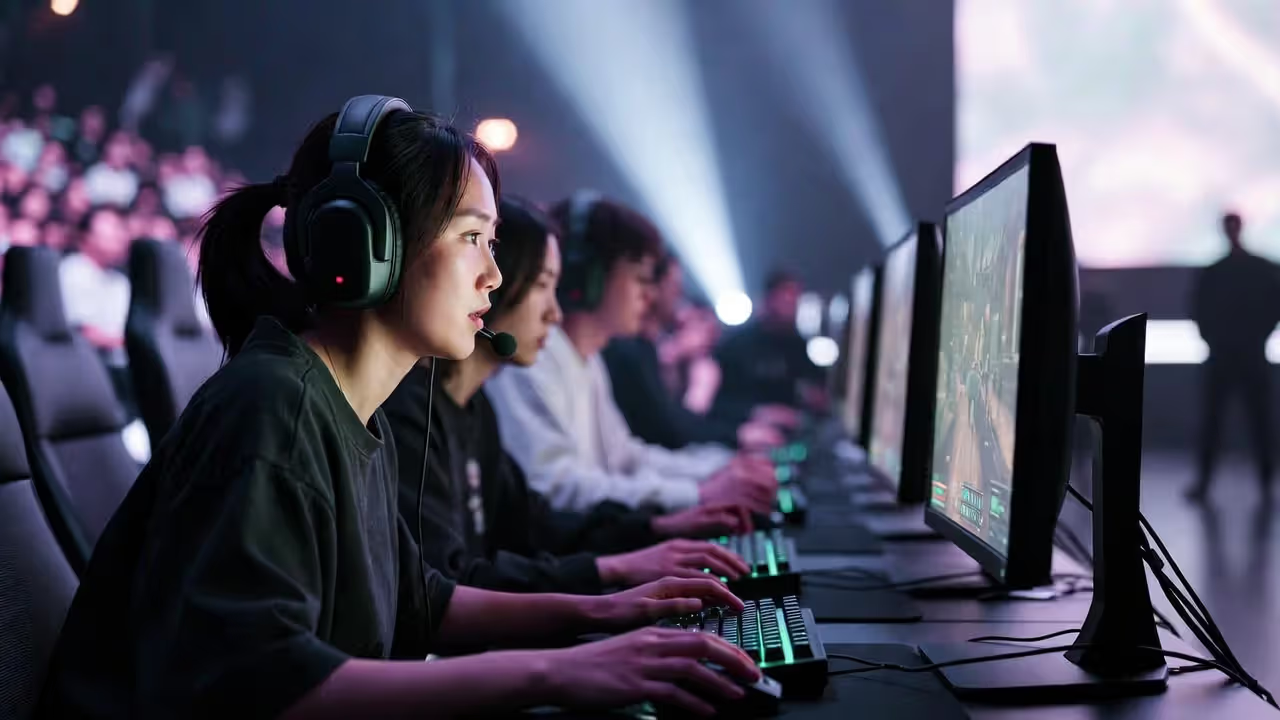
Sarah "Sarah Lou" Lachance dominates Valorant's Game Changers circuit with agent flexibility and clutch performances. She transitioned from Counter-Strike, bringing tactical depth that elevated her team's strategic approach. Her controller play stands out—positioning and game sense mattering as much as raw mechanical aim.
Author: Brandon Hayes;
Source: quantumcatanimation.com
Sasha "Scarlett" Hostyn holds the record for highest career earnings by a woman in esports history. Her StarCraft II career spans over a decade, with wins against the world's best players—gender irrelevant. Scarlett's late-game macro and multi-pronged harassment earned genuine respect throughout the competitive community. Tournament earnings? Approximately $400,000, absolutely dwarfing most female players across all titles.
Katherine "Mystik" Gunn shifted to coaching and content creation eventually, but her 2008 Dead or Alive 4 championship marked a watershed moment. That $100,000 prize was the largest women's esports earnings at the time, proving major brands would invest in women's competition when properly structured.
Rumay "Hafu" Wang built her career across multiple titles—World of Warcraft arena, Hearthstone, Teamfight Tactics. That adaptability showcases something people overlook: identifying emerging opportunities and mastering new systems quickly matters just as much as mechanical skill. Hafu's streaming income now exceeds her tournament earnings, illustrating alternative paths within competitive gaming.
Kim "Geguri" Se-yeon broke into Overwatch League as the first woman signed to a team. Her Zarya mechanics were so precise opponents accused her of cheating, forcing her to replicate performances on camera publicly. She played for Shanghai Dragons during their historic losing streak and subsequent turnaround, handling immense pressure with consistent professionalism.
Marjorie "Kasumi Chan" Bartell competes across multiple fighting games, with particular success in Tekken. The FGC has historically featured more visible female competitors than team-based esports, partly because of individual rather than team competition structures. Kasumi's tournament consistency demonstrates the viability of multi-game specialization.
Tournament Wins and Career Earnings Breakdown
| Player | Primary Game | Notable Placements | Approx. Career Earnings | Years Active | Current Status |
| Scarlett | StarCraft II | 1st at IEM PyeongChang, 1st at ASUS ROG, 1st at WESG | $400,000+ | 2011–present | Competing actively |
| Geguri | Overwatch | 2nd in Apex S2, playoff appearance in OWL Stage 4 | $60,000+ | 2016–2020 | Streaming full-time |
| Sarah Lou | Valorant | Multiple 1st place VCT Game Changers, 1st at Knights Arena | $45,000+ | 2020–present | Playing for Shopify Rebellion |
| Mystik | Multi-title | 1st in CGS Championship, 1st in Dead or Alive 4 Championship | $122,000+ | 2005–2012 | Coaching and content |
| Hafu | Hearthstone/TFT | 1st at EGLX, multiple Twitch Rivals wins | $50,000+ | 2007–present | Streaming and competing |
| Kasumi Chan | Tekken 7 | Top 8 at EVO, Top 4 at Combo Breaker | $15,000+ | 2015–present | Competing actively |
| Potter | Valorant | 1st at VCT Game Changers as coach | N/A (coaching role) | 2020–present | Head coach for Evil Geniuses |
What Organizations Are Doing to Advance Esports Inclusion
Riot Games launched Game Changers in 2021, creating an actual tier-one circuit exclusively for women and marginalized genders in Valorant. Regional leagues, international championships, development pathways—the whole structure. Prize pools have grown annually. The 2023 championship offered $500,000, which still trails VCT Champions' $2.25 million but represents serious investment compared to previous women's tournaments.
The program deliberately avoids "women's league" terminology, focusing instead on marginalized genders to include non-binary and transgender players. This approach sparked debates about competitive fairness and category definitions. No consensus has emerged. Riot keeps adjusting policies based on community feedback and competitive integrity concerns.
ESL established the Female Global Challenge for Counter-Strike, providing LAN competition opportunities at a scale that didn't exist before. The circuit runs parallel to open competition—players can compete in both. Some use it as a development ground before attempting mixed rosters. Others build entire careers primarily within women's divisions.
Activision Blizzard created Overwatch League initiatives to increase diversity in Path to Pro programs. Implementation has been inconsistent, though. The company faced internal controversies regarding workplace culture, which undermined public diversity commitments pretty significantly. That disconnect between stated values and organizational behavior made some players skeptical of corporate diversity programs generally.
Gen.G built a comprehensive women's esports program spanning multiple titles, with dedicated coaching staff and training facilities. Their approach treats women's rosters as equivalent investments rather than marketing accessories. Early results look promising—their Valorant roster consistently places top-three in Game Changers events.
Smaller organizations like Dignitas and CLG Red pioneered women's Counter-Strike rosters years before larger orgs committed resources. These teams operated on minimal budgets. Players often maintained part-time jobs. Their persistence demonstrated demand existed even when financial support didn't.
How Aspiring Players Can Enter Women's Competitive Gaming Circuits
Reach high ranks in competitive matchmaking first. Non-negotiable. For most titles, you need top 1% minimum—Immortal in Valorant, Master in League of Legends, Faceit Level 8+ in Counter-Strike. Mechanical skill and game knowledge must be demonstrable before teams even consider trials. Networking doesn't substitute for proven performance.
Amateur leagues provide structured competition beyond solo queue. Organizations like Galorants, Dignitas Female, and various Discord communities run regular tournaments with modest prize pools. These serve dual purposes: improving under pressure and building a competitive resume. Winning amateur tournaments won't guarantee professional contracts, but consistent top placements get noticed.
VOD review separates improving players from stagnant ones. Record your matches and analyze decision-making. Why did that push fail? Was utility usage optimal? Could positioning have been adjusted? Professional players spend hours reviewing their own gameplay and studying opponents. Aspiring competitors need to do the same.
Build a personal brand through streaming or content creation. Teams increasingly value players who bring existing audiences—this attracts sponsors and generates media interest. A player with 500 consistent viewers has more negotiating power than an equally skilled player with no following. Some people hate this reality and want pure meritocracy. Ignoring it means leaving opportunities on the table, though.
Network within the competitive community. Join team Discords, participate in scrims, engage professionally with coaches and managers. When roster spots open, organizations often ask existing players for recommendations. Being known as reliable, coachable, and skilled increases chances of receiving tryout invitations substantially.
Women-specific organizations like Dignitas Female, Shopify Rebellion, and CLG Red occasionally hold open tryouts or accept applications. These opportunities appear sporadically—follow teams on social media and check websites regularly so you don't miss announcements. Prepare highlight reels in advance so you can submit applications quickly.
Consider alternative roles if playing doesn't materialize immediately. Coaching, analysis, and team management positions exist throughout esports. Potter transitioned from player to coach, eventually becoming Evil Geniuses' head coach—the first woman in that position for a tier-one Valorant organization. Her team's success opened doors for other women pursuing coaching careers.
Measuring Progress: Has Esports Equality Improved?
Participation metrics show modest improvement. A 2019 industry survey found approximately 5% of professional esports players were women. By 2023, that figure reached 7-8% depending on title and tier definitions. Progress exists. At this rate, though, gender parity remains decades away.

Author: Brandon Hayes;
Source: quantumcatanimation.com
Sponsorship data reveals mixed trends. More brands sponsor women's teams or individual female players now. Budget allocations remain heavily skewed, though. A 2023 analysis of disclosed sponsorship deals found women's teams received an average of $180,000 annually, while comparable men's teams averaged $650,000. The gap narrowed from 2018's 5:1 ratio to roughly 3.5:1—improvement, certainly, but hardly equality.
Viewership for women's competitions has grown substantially. Valorant Game Changers Championship 2023 peaked at 250,000 concurrent viewers, up from 80,000 in 2021. Counter-Strike's Female Global Challenge draws 30,000-50,000 viewers for finals. These numbers trail men's tier-one events significantly but represent genuine audience interest.
Prize pool analysis shows both progress and persistent gaps. Total prize money available in women's divisions across all games increased from approximately $2 million in 2018 to $8 million in 2023. Men's prize pools grew from $180 million to $320 million in the same period, however. The absolute gap widened even as women's competitions received more investment.
Team salary data remains largely undisclosed, making comprehensive analysis difficult. Leaked information and player statements suggest women on tier-one organization rosters now earn livable salaries—typically $30,000-$60,000 annually plus housing. This represents substantial improvement from five years ago, when most women's rosters operated unpaid or with minimal stipends.
Representation in broadcast and production roles has improved noticeably. Women regularly appear as analysts, hosts, and observers across major tournaments now. Sjokz (Eefje Depoortere) became one of League of Legends' most recognizable broadcast personalities. Goldenboy (Alex Mendez) and others actively advocate for diverse broadcast teams, gradually normalizing women's presence in all tournament roles.
Expert Perspective on Industry Change
We've shifted from questioning whether women belong in esports to debating how to accelerate their success. That shift matters, but we can't mistake it for arrival. Structural barriers remain—harassment, sponsorship gaps, and development pipeline issues won't resolve without deliberate intervention. The industry must decide whether it wants diversity as a marketing talking point or as an operational reality, because those require very different commitments.
— Morgan Romine, Strategic Director, AnyKey
Frequently Asked Questions About Women in Esports
Competitive gaming's gender gap mirrors broader technology industry patterns while presenting unique challenges tied to gaming culture and online anonymity. Progress has accelerated in recent years through deliberate programs, increased investment, and cultural shifts within gaming communities. Substantial work remains, though, before female esports players compete on genuinely equal footing.
Achieving meaningful change demands commitment from everyone involved. Tournament organizers must balance separate divisions' immediate benefits against long-term integration goals. Teams need to evaluate talent without gender-based assumptions about team dynamics or marketability. Sponsors should recognize that developing markets requires patience and sustained commitment. Gaming communities must enforce behavioral standards that make competitive spaces accessible to everyone.
For aspiring female players, the landscape offers more opportunities than ever before. Navigating it still requires exceptional skill, resilience, and strategic career management, though. The players succeeding today are building infrastructure that future generations will inherit—a responsibility they didn't ask for but have shouldered regardless.