
What Makes Exploration Games the Ultimate Discovery Experience in Gaming
Exploration Games Guide To Discovery Mechanics

Content
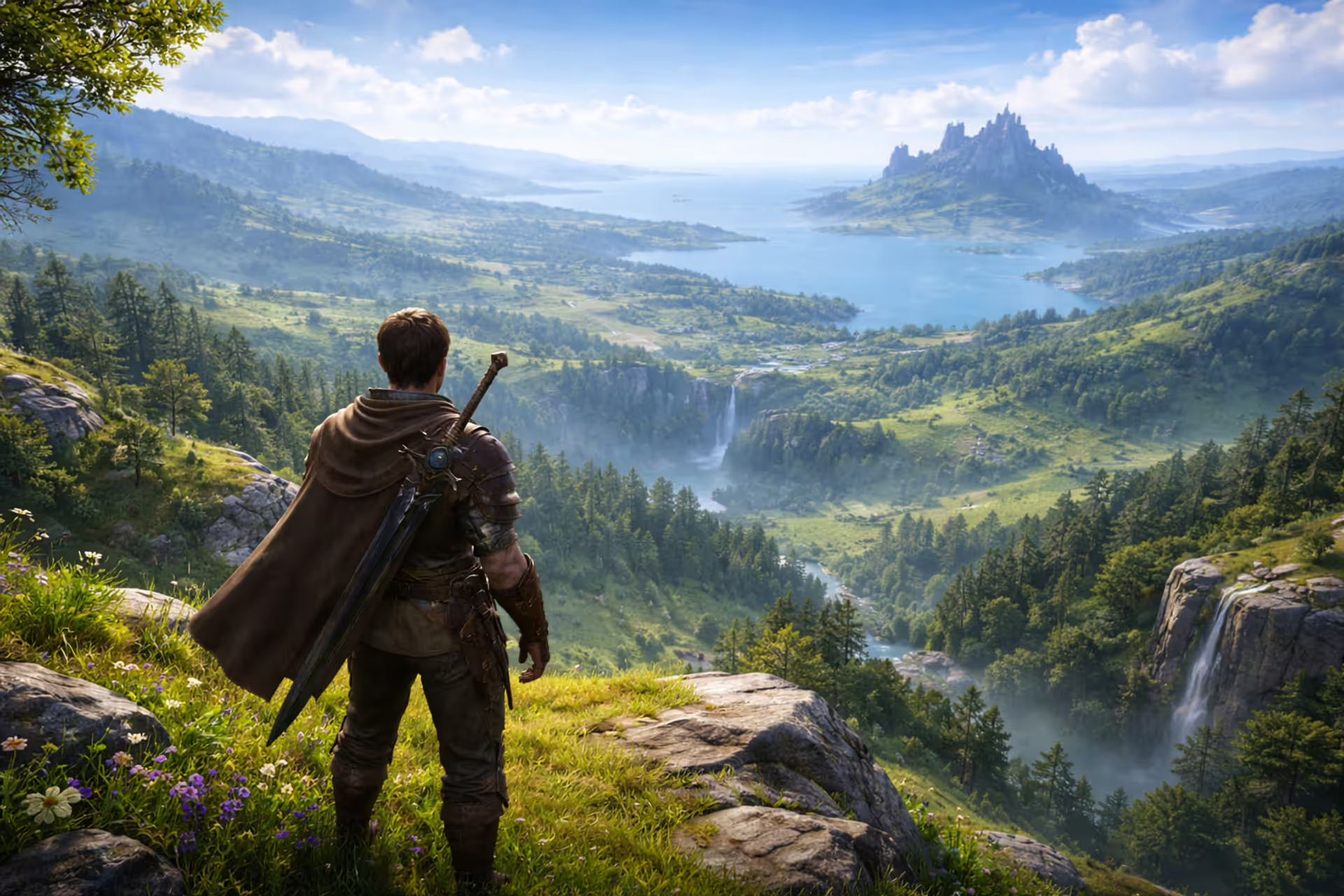
Exploration games strip away the noise. No quest markers pointing you toward the next objective. No glowing breadcrumb trails. Just you, an environment rich with secrets, and the raw curiosity that drives you to see what lies beyond that ridge or inside that cave system. This genre thrives on player-driven discovery, where the act of finding something new delivers more satisfaction than any scripted cutscene.
The best titles in this space understand a fundamental truth: players remember the moments they earned through curiosity far longer than the rewards handed to them. A hidden pathway you noticed because of a subtle change in wall texture. An island you spotted on the horizon and decided to swim toward. These moments define why exploration games create experiences that stick with players years after the credits roll.
How Exploration Mechanics Drive Player Engagement
Exploration games build their core gameplay loops around environmental investigation and spatial problem-solving. Unlike action games where combat encounters provide the primary engagement, or puzzle games where specific challenges gate progress, exploration titles reward attention to environmental detail and spatial reasoning.
The loop typically follows this pattern: observe environment → form hypothesis about what might be hidden or accessible → test that hypothesis → receive validation (or learn why the approach failed) → apply that knowledge elsewhere. This cycle repeats hundreds of times across a playthrough, creating a self-reinforcing engagement system that doesn't rely on external motivation.
Environmental storytelling plays a crucial role here. Rather than explaining lore through exposition dumps, these games scatter narrative fragments throughout the world. A skeleton clutching a map near a collapsed bridge tells you something happened here. The specific items in an abandoned campsite reveal who these people were and what they valued. Players piece together stories through spatial archaeology, which creates investment in the world itself.
Reward systems in exploration games operate differently than loot-driven titles. Finding a new area often serves as its own reward—the satisfaction comes from accessing previously unreachable spaces. Secondary rewards like equipment upgrades or lore entries enhance the experience but don't drive it. This creates a purer form of engagement where the journey genuinely matters more than the destination.
Author: Tyler Brooks;
Source: quantumcatanimation.com
The Psychology Behind Discovery-Based Gameplay
Human brains release dopamine not just when receiving rewards, but when anticipating them. Exploration games exploit this mechanism brilliantly. That distant structure might contain something valuable. The unusual rock formation could hide a passage. The anticipation of discovery triggers the same neural pathways as the discovery itself.
This anticipation-reward cycle explains why empty spaces in exploration games don't feel wasted. The possibility that something might be hidden maintains engagement even when you find nothing. However, this only works when the game establishes trust—players need to learn through experience that their curiosity gets rewarded often enough to justify continued investigation.
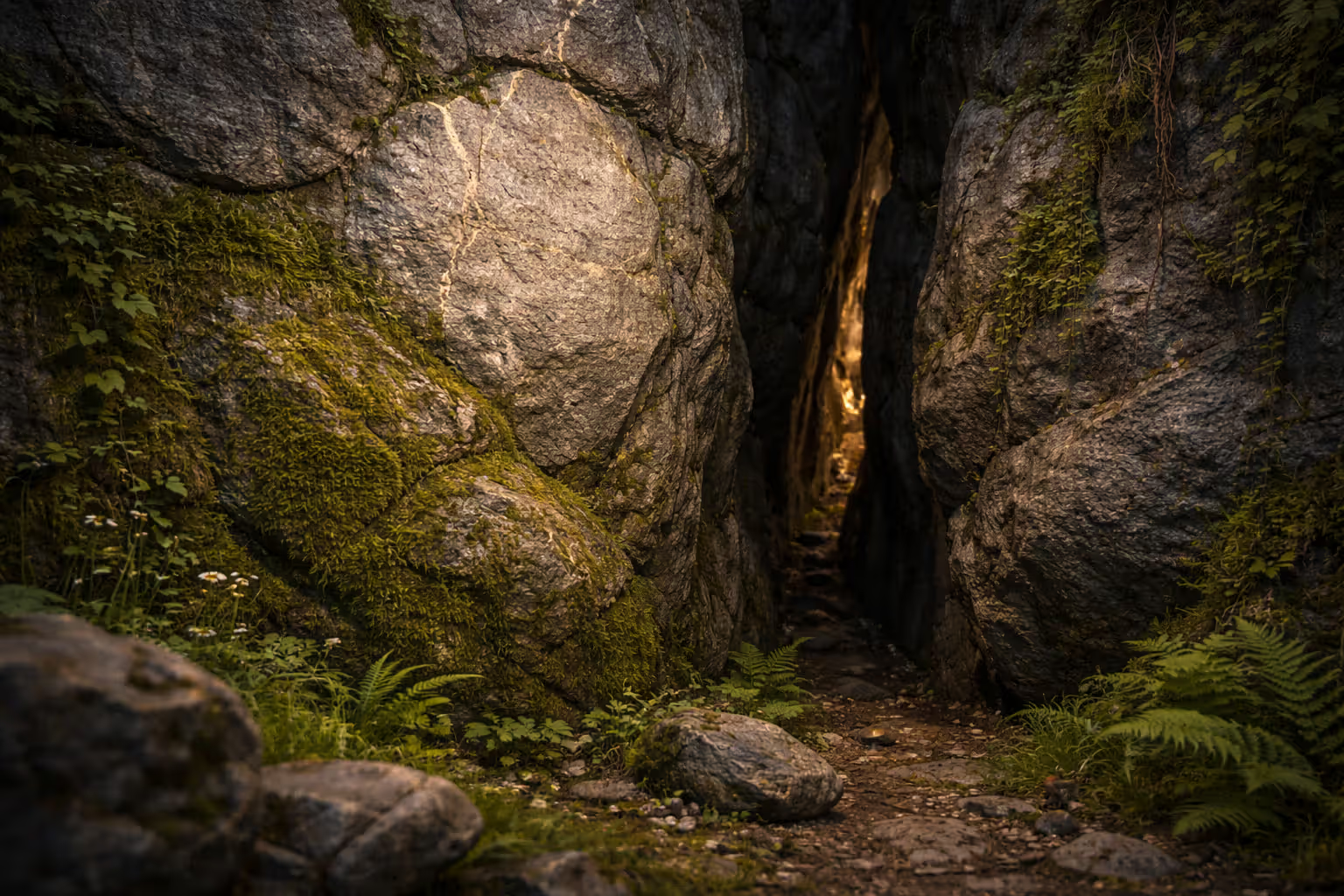
Pattern recognition also drives engagement. Once you learn that a specific visual cue (moss-covered walls, unusual architecture, environmental anomalies) signals hidden content, you start actively scanning for those patterns. This transforms passive observation into active investigation, fundamentally changing how players perceive and interact with game spaces.
Reward Structures That Keep Players Exploring
Effective exploration games layer multiple reward types to maintain momentum across different player motivations. Intrinsic rewards (the satisfaction of discovery) appeal to curious players. Extrinsic rewards (upgrades, collectibles) motivate completionists. Narrative rewards (lore, story progression) engage players invested in the world's fiction.
The timing and pacing of these rewards matters enormously. Place rewards too close together and exploration feels guided rather than discovered. Space them too far apart and players lose motivation. The sweet spot varies by game scope, but a useful rule of thumb: players should encounter something noteworthy every 3-5 minutes of active exploration.

Author: Tyler Brooks;
Source: quantumcatanimation.com
Graduated rewards create escalating satisfaction. Early discoveries might yield minor upgrades or interesting environmental details. Mid-game exploration reveals significant abilities or narrative revelations. Late-game secrets reward dedicated players with content that recontextualizes earlier experiences. This structure ensures that exploration remains worthwhile throughout the entire playthrough.
5 Design Principles That Define Great Exploration Games
1. Readable Environments With Subtle Guidance
Great exploration games communicate navigational information without explicit waypoints. Distant landmarks provide orientation. Environmental features (rivers, mountain ranges, distinctive structures) create natural navigation aids. Lighting draws attention to paths forward without forcing specific routes. Players feel autonomous while never becoming completely lost.
The key distinction: guidance versus direction. Direction tells players where to go. Guidance gives them tools to figure it out themselves. Subnautica uses biome color palettes and depth as navigational information. Players learn that red-tinted waters indicate dangerous zones, while specific flora signals resource availability. This environmental literacy develops naturally through exploration.
2. Meaningful Spatial Design
Every area should justify its existence through unique geography, distinct challenges, or specific narrative purpose. Copy-pasted environments kill exploration because players stop paying attention to detail. When each location offers something distinct, players maintain active observation.
Verticality adds exploration depth that flat terrain cannot provide. Climbing systems, underground networks, and aerial traversal create three-dimensional spaces where secrets hide above and below the obvious paths. This spatial complexity rewards thorough investigation while making environments feel larger than their actual footprint.
3. Gated Progression With Multiple Solutions
Metroidvania-style progression gates work beautifully in exploration games, but rigid gating frustrates players. The best implementations offer multiple paths forward. Can't access the high ledge yet? Perhaps the underwater route provides an alternative. This flexibility respects player agency while maintaining the satisfaction of returning to previously inaccessible areas with new abilities.
Progression gates should feel logical within the world. A locked door requires a key—straightforward but artificial. A gap too wide to jump becomes crossable after finding climbing gear—this feels earned. Environmental obstacles that require specific tools or abilities to overcome create organic gates that enhance rather than interrupt exploration.
4. Secrets That Reward Observation
Hidden content should follow consistent internal logic. If breakable walls look different from solid walls, that visual language needs to remain consistent. If certain environmental features always signal secrets, players learn to recognize those patterns. Arbitrary hidden content frustrates; logically discoverable secrets delight.
The difficulty curve for secrets matters. Early secrets should be relatively obvious to train players what to look for. Mid-game secrets require applying learned patterns in new contexts. Late-game secrets demand mastery of the game's visual language and mechanics. This progression ensures secrets remain satisfying challenges rather than random chance.
5. Player Agency in Exploration Order
The best exploration games don't tell you where to go—they make you want to see what's around the next corner.
— Hidetaka Miyazaki, FromSoftware
Linear exploration contradicts the genre's core appeal. Players need meaningful choices about where to explore and when. This doesn't require complete open-world freedom—carefully designed semi-linear spaces can offer substantial agency while maintaining curated experiences.
Agency also applies to how players explore. Multiple traversal options (climbing, swimming, gliding) let players approach spaces from different angles. Some players prefer methodical area-by-area clearing. Others follow whatever catches their interest. Robust exploration games accommodate both approaches without punishing either.
Exploration vs. Other Game Genres: A Direct Comparison
| Feature | Exploration Games | Action-Adventure | RPGs | Walking Simulators |
| Primary Focus | Environmental discovery and spatial navigation | Combat encounters with exploration elements | Character progression and narrative choices | Narrative delivery and atmosphere |
| Player Agency | High—players choose where and how to explore | Medium—story missions guide most activities | Medium to High—depends on specific title | Low to Medium—usually linear paths |
| Combat Importance | Optional to secondary | Core mechanic | Core mechanic with stat-based systems | Usually absent |
| Pacing | Player-determined, self-directed | Developer-controlled through missions | Mixed—story pacing with open exploration | Strictly developer-controlled |
| Typical Playtime | 15-40 hours | 12-25 hours | 30-100+ hours | 2-6 hours |
| Skill Requirements | Spatial reasoning, observation, pattern recognition | Reflexes, combat mastery, timing | Strategic planning, build optimization | Minimal mechanical skills |
When Exploration Becomes the Primary Gameplay Loop
Exploration graduates from feature to core loop when discovery drives progression more than any other system. In Outer Wilds, exploration is progression—the only thing that advances between loops is your knowledge. Combat doesn't exist. Character stats don't improve. You become more capable by understanding the world's spatial and temporal patterns.
This shift fundamentally changes how players approach the game. Rather than asking "What do I need to do next?" players ask "What haven't I discovered yet?" The distinction seems subtle but creates entirely different engagement patterns. Quest-driven games provide external motivation. Exploration-driven games cultivate internal curiosity.
The risk with exploration-primary design: players need enough initial hooks to develop that curiosity. Strong opening hours that demonstrate the satisfaction of discovery prove essential. Once players experience that first major revelation from exploring thoroughly, they'll chase that feeling throughout the rest of the game.
Common Mistakes Developers Make With Discovery Gameplay Design
Unclear Signposting Boundaries
Players need to distinguish between "I haven't figured this out yet" and "I can't access this yet." When games blur this line, exploration turns into frustrating trial-and-error. Clear visual language separating current content from gated content respects player time. A locked door communicates clearly. An invisible wall masquerading as an accessible path breeds frustration.
Empty Worlds Disguised as Exploration
Large spaces without discovery opportunities waste player time. If traveling between points of interest offers nothing to discover, that's not exploration—it's padding. Effective exploration games fill traversal time with optional discoveries. Even the journey between major locations should offer small rewards for attention.

Author: Tyler Brooks;
Source: quantumcatanimation.com
False Exploration That Funnels to Single Paths
Creating the illusion of open exploration while actually offering only one viable route forward undermines player agency. Branching paths that all lead to the same chokepoint feel deceptive. If the game design requires specific progression order, own that structure rather than pretending otherwise.
Repetitive Rewards That Devalue Discovery
When the 50th hidden chest contains the same generic resources as the previous 49, exploration loses meaning. Rewards don't need to be mechanically powerful, but they should feel distinct. Unique cosmetics, lore entries, or even just visually interesting locations work better than identical loot drops.
Poor Pacing That Exhausts Curiosity
Front-loading too many discoveries burns through content too quickly. Back-loading major revelations risks losing players before they reach the payoff. Effective pacing distributes significant discoveries throughout the experience, with escalating impact as players progress.
12 Exploration Games That Perfected Discovery Mechanics
Outer Wilds masters knowledge-based progression. Every discovery adds to your understanding of the solar system's interconnected mysteries. The 22-minute time loop creates perfect bite-sized exploration sessions while encouraging experimentation without consequence.
Subnautica uses depth as both literal and metaphorical progression. Descending into darker, more dangerous waters mirrors the player's growing confidence and capability. Environmental storytelling through wreckage and abandoned bases creates narrative without interrupting exploration.
The Legend of Zelda: Breath of the Wild proves that massive open worlds can maintain discovery density. The "climb anything" philosophy removes artificial barriers while the stamina system creates organic limitations. Shrines and Korok seeds provide constant small-scale discoveries between major locations.
Metroid Prime translates 2D Metroidvania progression into 3D space brilliantly. Scanning mechanics transform combat arenas into research opportunities. Returning to previous areas with new visors reveals hidden layers, making familiar spaces feel fresh.
Hollow Knight demonstrates how 2D spaces can offer exploration depth rivaling 3D games. Interconnected areas with multiple entry points create complex spatial puzzles. The map system requiring players to purchase maps and manually update them enhances the exploration experience.
Elden Ring applies FromSoftware's level design mastery to open-world structure. Legacy dungeons offer curated exploration experiences while the open world rewards curiosity with unique encounters and optional content. Minimal UI lets environments speak for themselves.
Return of the Obra Dinn makes investigation itself the core mechanic. Players explore a frozen moment in time, piecing together what happened through careful observation and logical deduction. Discovery here means understanding rather than finding.
The Witness transforms puzzle-solving into environmental exploration. Solutions hide in the environment itself, requiring players to observe and understand their surroundings. The island becomes a massive interconnected puzzle where exploration and problem-solving merge.
A Short Hike proves exploration games don't need dozens of hours to succeed. The compact island offers surprising discovery density, with meaningful secrets rewarding thorough exploration. The relaxed pacing lets players explore at their own rhythm.
Tunic hides its instruction manual pages throughout the world, making discovery of game mechanics part of exploration. Players explore both the physical space and the game's systems simultaneously, with each informing the other.
Sable focuses on exploration without combat or fail states. Climbing, gliding, and hoverbike traversal create meditative exploration. The coming-of-age narrative unfolds through environmental storytelling and optional conversations.
Rain World creates hostile environments where exploration requires learning ecosystem patterns. Creatures follow consistent behavioral rules, turning exploration into a study of interconnected systems. High difficulty makes successful exploration genuinely rewarding.
Author: Tyler Brooks;
Source: quantumcatanimation.com
How to Identify Quality Exploration Games Before You Buy
Green Flags to Look For:
Player reviews mentioning "I got lost for hours" or "I kept finding new things" indicate strong exploration loops. When players lose track of time exploring, the game has succeeded.
Gameplay footage showing players stopping to investigate environmental details rather than rushing through spaces suggests meaningful exploration. Watch for moments where streamers notice something subtle and choose to investigate.
Developer discussions emphasizing environmental storytelling and player agency over scripted sequences signal exploration-focused design philosophy. Studios that understand why players explore create better exploration games.
Red Flags to Watch For:
Excessive quest markers and waypoints in promotional footage suggest the game doesn't trust players to explore independently. Heavy UI elements often compensate for weak environmental design.
Reviews complaining about "not knowing where to go" might indicate poor environmental communication, but context matters. Some players want explicit direction while others prefer discovery. Read multiple reviews to distinguish between design philosophy and design failure.
Comparisons to "walking simulator" as a negative (rather than genre descriptor) sometimes signal empty environments with minimal discovery opportunities. Look for specific complaints about lack of interactive elements or meaningful discoveries.
Marketing emphasizing world size over world density raises concerns. "Explore 500 square kilometers" means nothing if those kilometers contain nothing worth discovering. Quality exploration games focus on discovery density rather than raw size.
FAQ: Your Questions About Exploration Games Answered
Exploration games succeed by respecting player curiosity. They create spaces worth investigating, provide tools to navigate those spaces, then step back and let discovery happen organically. The genre's best examples understand that meaningful exploration requires more than large maps—it demands carefully crafted environments that reward attention, consistent visual language that teaches players what to look for, and progression systems that make discovery feel earned rather than handed out.
Whether you're navigating Outer Wilds' solar system, diving deeper into Subnautica's alien ocean, or climbing every surface in Breath of the Wild, these games tap into the fundamental human drive to see what's over the next hill. They prove that in gaming, the questions "What's over there?" and "Can I reach that?" remain powerful enough to drive dozens of hours of engagement when answered with thoughtful design.
The exploration genre continues evolving as developers discover new ways to make discovery satisfying. Each successful title teaches the industry more about what makes exploration compelling, pushing the genre forward while honoring the core principle: give players interesting spaces and the freedom to investigate them, and curiosity handles the rest.