A decade that redefined home gaming
16 Bit Games Explained

Content
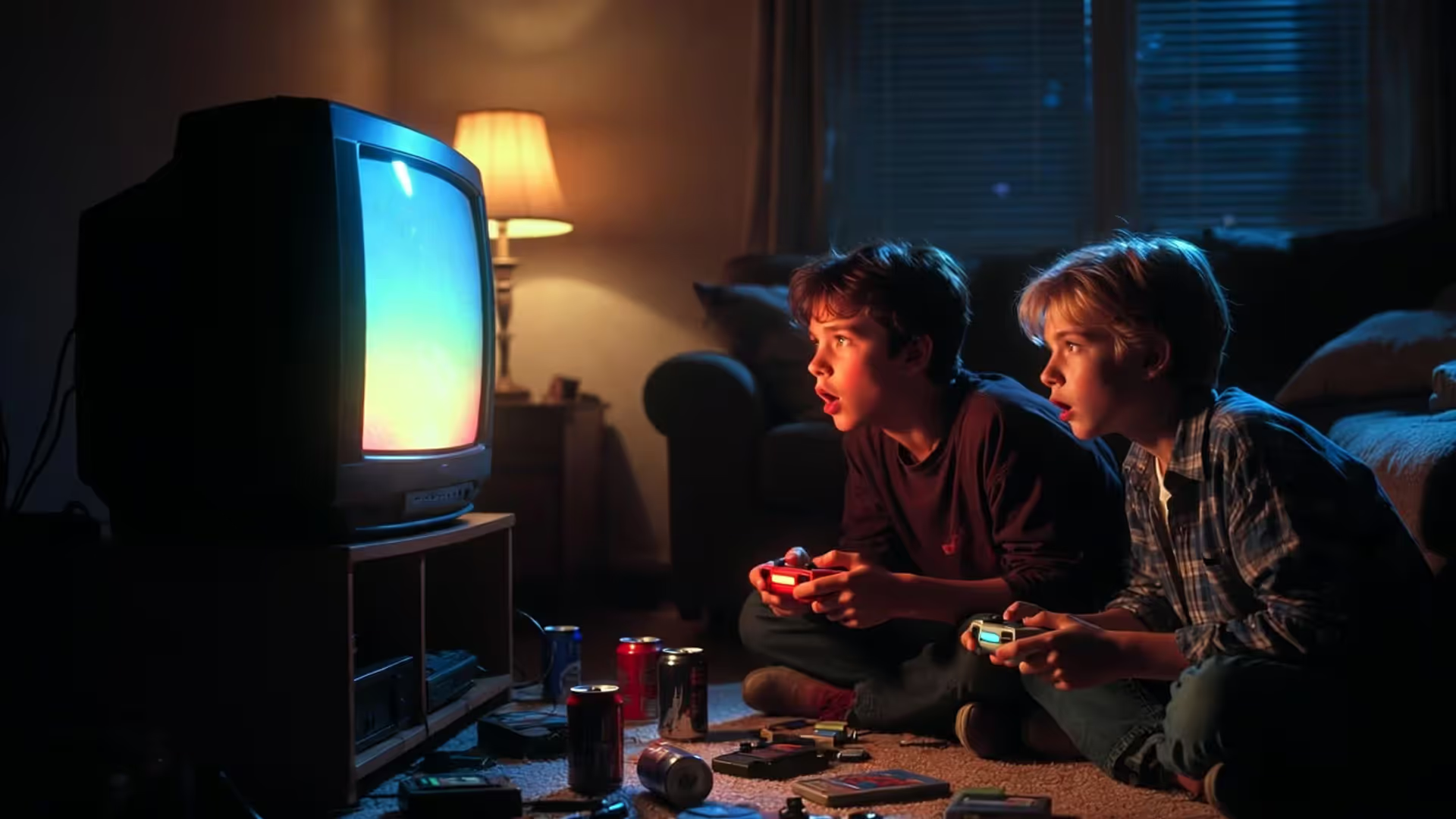
From 1988 through 1998, something shifted in living rooms worldwide. Consoles like the Super Nintendo and Sega Genesis didn't just offer better graphics—they made worlds feel tangible in ways the NES never could. You could hear actual drum samples in game soundtracks. Background layers scrolled at different speeds, creating genuine depth. Characters had enough pixels to show emotion on their tiny faces. For millions of players, this was the first time a game console felt less like a toy and more like a portal.
What Made 16 Bit Games a Revolutionary Leap Forward
Numbers tell part of the story, but not the interesting part. Yes, 16-bit processors handled double the data per cycle compared to their 8-bit predecessors. The real transformation? Developers finally had breathing room to execute ideas they'd been sketching in notebooks for years.
Take color depth. The NES could show 52 colors simultaneously—decent for 1985, but limiting. SNES pulled from a palette of 32,768 possible colors and displayed 256 at once. That's not just "more colors." That's the difference between solid blue water and water with light refracting through it. Between a red enemy and an enemy that looks wounded, bleeding, dangerous.
Audio technology made equally dramatic leaps. SNES featured eight-channel ADPCM sampling, meaning composers could record actual instruments and play them back through the console. No more approximating a trumpet with beeps—you could sample a real trumpet. Sega's Yamaha YM2612 chip took a different approach with FM synthesis, creating the aggressive, bass-heavy soundscapes that made Streets of Rage and Sonic sound like nothing else. Yuzo Koshiro specifically chose Genesis hardware for Streets of Rage because he wanted that FM synthesis punch for his electronic dance music compositions.
Mode 7 changed how players perceived space. Nintendo's SNES could rotate and scale entire background layers in real-time. F-Zero's race tracks curved into the horizon. Pilotwings created the sensation of flight. These weren't truly 3D environments—just clever manipulation of 2D planes—but your brain believed it. Sega eventually answered with the Sega Virtua Processor for Virtua Racing, pushing actual polygons through a sprite-based system.
Storage capacity expanded from 512KB cartridges to 6MB by the mid-90s. That headroom meant Final Fantasy VI could tell a story with fourteen playable characters, each with their own subplot. Chrono Trigger could track complex combo systems where characters executed joint attacks based on positioning and timing. These systems would've overwhelmed 8-bit hardware the moment you entered battle.
Author: Tyler Brooks;
Source: quantumcatanimation.com
SNES vs. Sega Genesis: The Console War That Changed Everything
Nintendo and Sega built fundamentally different machines, then spent a decade arguing about whose philosophy worked better. Spoiler: both did, just for different experiences.
Hardware Architecture Differences
Here's how the two systems compared under the hood:
| Specification | Super Nintendo | Sega Genesis |
| Processor | 3.58 MHz (Ricoh 65c816) | 7.67 MHz (Motorola 68000) |
| Available Colors | 32,768 total palette | 512 total palette |
| Audio Hardware | 8-channel sample playback | Yamaha YM2612 FM chip |
| Display Output | 256×224 up to 512×448 | 320×224 standard |
| System Memory | 128KB main RAM | 64KB main RAM |
| US Launch Cost | $199 in August 1991 | $189 in August 1989 |
| Lifetime Sales | 49.1 million worldwide | 30.75 million worldwide |
Sega shipped first—two full years before Nintendo in the US market. That head start mattered enormously. By the time SNES launched, Genesis already had Sonic, Golden Axe, and Altered Beast establishing its identity. Sega's marketing hammered home "blast processing," a mostly meaningless term that technically referred to DMA capabilities but really just meant "fast."
The CPU speed difference had real consequences. Genesis scrolled smoother and handled more simultaneous enemies. Play Contra: Hard Corps on Genesis—the screen fills with bullets, explosions, and enemies without slowdown. SNES struggled with that density. But Nintendo's slower processor executed more complex instructions per cycle, which is why SNES became the RPG powerhouse. Final Fantasy VI tracking dozens of variables per battle? No problem. Mode 7 calculations for Super Mario Kart? Handled natively.
Author: Tyler Brooks;
Source: quantumcatanimation.com
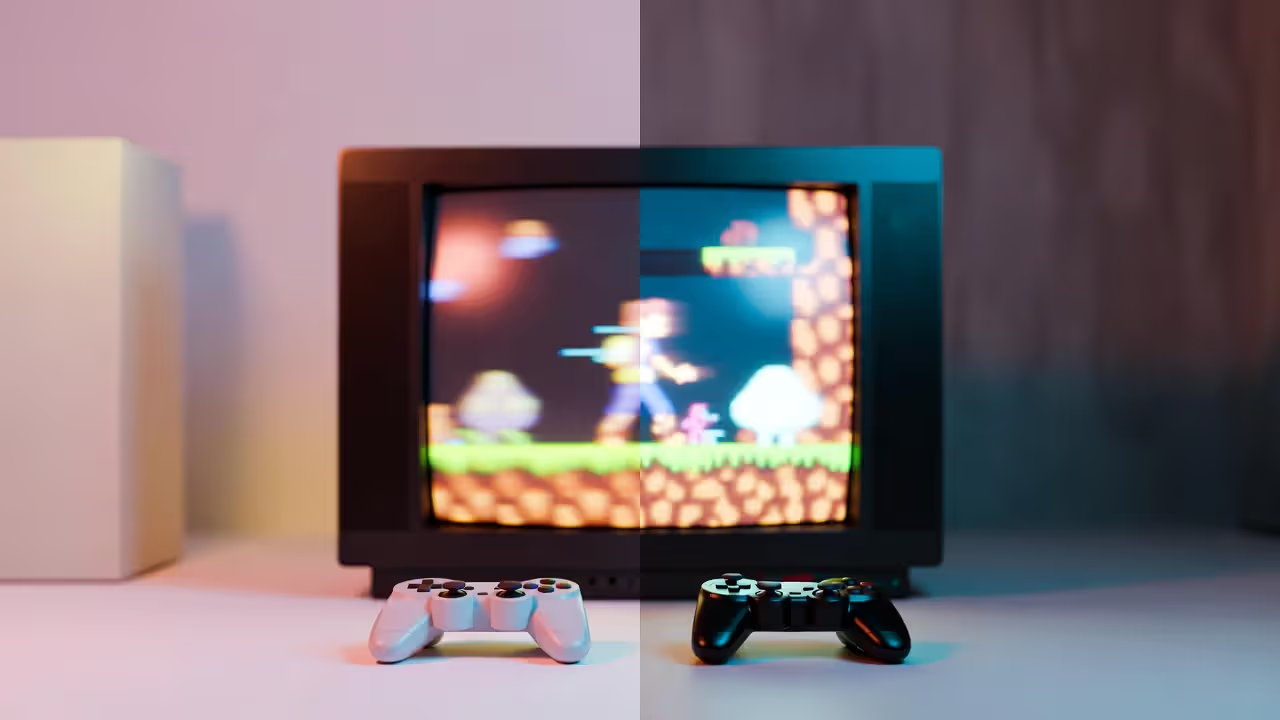
Color capabilities created distinct visual identities. SNES games had subtle gradients, atmospheric lighting, softer edges. Genesis titles looked sharper, higher contrast, almost harsh by comparison. Neither approach was objectively better—they suited different game types. Donkey Kong Country's pre-rendered graphics needed SNES's color depth. Sonic's speed demanded Genesis's crisp, high-contrast visuals for readability.
Exclusive Titles That Defined Each Platform
Nintendo locked down Square and Enix, which meant RPG fans had one choice. Final Fantasy VI, Chrono Trigger, Secret of Mana, Dragon Quest V—all SNES exclusives. These 40-60 hour epics justified the console's premium price and showcased what 4-6MB cartridges could do with storage. Chrono Trigger alone had 13 different endings and a New Game+ mode that let you replay with endgame stats.
Sega courted arcade developers and speed-focused designers. Sonic's momentum-based platforming required frame-perfect scrolling that Genesis delivered reliably. Treasure's Gunstar Heroes threw 80+ sprites on screen simultaneously—bosses that filled the entire display with intricate patterns. Sports games like NHL '94 ran at 60fps, crucial for multiplayer competitiveness.
Third-party publishers often built entirely separate games rather than straight ports. Aladdin had two versions: Virgin's Genesis game featured rotoscoped animation from the Disney film and sword-based combat. Capcom's SNES version emphasized precision platforming and tighter level design. Different teams, different engines, different gameplay philosophies. Same license, completely distinct experiences.
Author: Tyler Brooks;
Source: quantumcatanimation.com
How 16 Bit Gameplay Design Still Influences Today's Indie Scene
Walk into any indie game showcase and you'll see 16-bit design principles everywhere. Not just pixel art aesthetics—the fundamental mechanical decisions that hardware limitations forced developers to solve.
Limited sprites meant every enemy needed an instantly recognizable silhouette. You can identify a Metroid creature or a Streets of Rage punk from their outline alone. Modern games like Hollow Knight follow the same principle. Every enemy type has a distinct shape, size, and movement pattern that you recognize before seeing details. That clarity emerged from necessity but proved essential for readable game design.
Collision detection rules from this era became universal standards. Player hitboxes slightly smaller than visible sprites make dodging feel fair. Enemy attacks telegraph with distinct wind-up animations—you get hit because you made a mistake, not because the game cheated. Invincibility frames after taking damage prevent stunlock death spirals. These weren't design philosophies in 1992—they were workarounds for hardware constraints. They persisted because players responded positively.
The 16-bit era taught us that limitations breed creativity. We had 256 colors, so we mastered color theory. We had limited ROM space, so every dialogue line mattered. Modern tools let us build anything, but the best games still follow those principles of intentional design.
— Ron Gilbert
The entire Metroidvania genre wouldn't exist without Super Metroid's interconnected world and Castlevania: Symphony of the Night's RPG progression. Both games used expanding cartridge sizes to create sprawling environments that rewarded exploration. You couldn't access certain areas without specific power-ups, encouraging backtracking with new abilities. Ori and the Blind Forest, Axiom Verge, Hollow Knight—all follow that structural template established during the 16-bit generation.
Street Fighter II crystallized fighting game fundamentals: six-button layout, quarter-circle special move inputs, frame data determining advantage/disadvantage states. Every fighting game since—even modern titles like Street Fighter 6 and Guilty Gear Strive—references Capcom's 1991 blueprint. Light/medium/heavy attack hierarchies, command grabs, reversal windows during opponent's attacks. These mechanics emerged on 16-bit hardware and never left.
Pixel art remains commercially viable because 16-bit resolution hits a perfect balance. It's detailed enough for expressive characters but simple enough for small teams to produce. Stardew Valley, Eastward, Blasphemous—all use 16-bit-style sprites not purely for nostalgia, but because a talented pixel artist can convey personality in a 32×32 sprite that would require an entire 3D animation team and budget.

Author: Tyler Brooks;
Source: quantumcatanimation.com
The Most Valuable Sega Genesis Classics Worth Collecting in 2025
Genesis collecting exploded after 2020. Certain titles appreciated 300-400% as millennials with disposable income started hunting childhood memories. Understanding market forces helps you avoid overpaying for common games while spotting undervalued gems before prices spike.
Crusader of Centy regularly sells for $800-1,200 complete in box. Why? Late 1994 release meant limited print run, and its Zelda-like gameplay attracts crossover collectors from the Nintendo crowd. Pier Solar—a 2010 homebrew release—commands $400-600 because only 800 physical copies were manufactured. Scarcity drives premium pricing more than gameplay quality.
Mid-range collectibles ($150-400) include Phantasy Star IV, Castlevania Bloodlines, and Rocket Knight Adventures. These had decent production numbers but strong gameplay that maintains demand. Condition drastically affects value here. Complete-in-box with a crushed corner might sell for 40% less than pristine copies. Box quality matters more than cartridge condition for serious collectors.
Common games consistently overpriced at tourist-area retro stores: Sonic 2 (6 million copies printed), NBA Jam, Mortal Kombat II. These shouldn't exceed $15-20 loose. Stores charge $40-50 banking on uninformed nostalgia purchases. Always check PriceCharting.com for actual sold listings before buying anything over $30.
Regional differences create pricing opportunities. European PAL versions run 17% slower due to 50Hz refresh rate versus 60Hz, making them less desirable for playing but equally valuable for sealed collectors. Japanese Mega Drive cartridges work on US Genesis consoles with a $15 adapter, opening access to titles like Bare Knuckle III (the superior Japanese version of Streets of Rage 3) at fractions of US market prices.
Spotting reproduction cartridges requires opening the shell. Authentic games use mask ROM chips with manufacturer stamps and date codes. Reproductions use modern EEPROM chips with recent dates—immediate red flag. Original Genesis labels have specific texture and slight color variation under magnification. Counterfeiters typically get font spacing wrong, especially on the SEGA logo. For purchases over $100, request internal board photos before committing.
Storage mistakes destroy value faster than playing games. Cardboard boxes stored above 50% humidity absorb moisture, leading to warping and mold. Cartridges in dusty environments develop corroded contacts causing glitches and artifacts. Direct sunlight fades label printing within three months. Use climate-controlled spaces with archival-quality protective cases, or accept that displayed items will degrade noticeably.
Retro Graphics Evolution: From Sprites to Pre-Rendered 3D
The 16-bit generation lasted nearly ten years, and visual techniques evolved dramatically as developers mastered the hardware's quirks.
16-Bit Visual Evolution Timeline:
| Release Year | Innovation | Landmark Title | What Changed Visually |
| 1989 | Refined sprite work, static layers | Golden Axe | Crisp character art, minimal animation |
| 1991 | Multi-layer parallax scrolling | Sonic the Hedgehog | Background depth through independent movement |
| 1992 | Mode 7 plane manipulation | Super Mario Kart | Curved racing surfaces, pseudo-3D rotation |
| 1993 | Color dithering techniques | Donkey Kong Country | Gradient illusions using alternating pixels |
| 1994 | Pre-rendered 3D converted to sprites | Donkey Kong Country | Characters with apparent volume and shadow |
| 1995 | Transparency layering effects | Yoshi's Island | See-through elements, atmospheric effects |
| 1996 | Dynamic lighting on sprites | Vectorman | Real-time shadows and highlights |
| 1997 | Hybrid 2D/3D rendering | Castlevania: SOTN | Polygonal backgrounds, sprite characters |
Early releases like Altered Beast and Ghouls 'n Ghosts essentially delivered polished arcade ports—better color counts and smoother animation than NES, but compositionally flat. Developers hadn't yet discovered how to exploit hardware layering capabilities effectively.
Mid-generation breakthroughs came from teams with deep hardware knowledge. Nintendo's Star Fox used the Super FX chip to render polygons natively. Treasure's Gunstar Heroes displayed 80+ sprites simultaneously without flicker—something that looked impossible on the same hardware running 1989 launch titles.
Author: Tyler Brooks;
Source: quantumcatanimation.com
Donkey Kong Country shocked everyone in 1994. Players assumed they were seeing next-generation visuals. Rare's technique: model characters in 3D on Silicon Graphics workstations, render from multiple angles, compress those images into sprites, then animate them frame-by-frame. The result looked pseudo-3D in a way that still photographs couldn't quite capture. You had to see it moving.
Late-era developers pushed transparency effects the hardware wasn't designed to support. Yoshi's Island's hand-drawn aesthetic exploited every color and layering trick available, creating visuals that remain distinctive three decades later. Rendering those effects required custom chips embedded in cartridges themselves, raising production costs significantly but delivering visuals that stood apart from early PlayStation releases.
Common Mistakes When Starting a 16 Bit Game Collection
New collectors make predictable errors, usually learning expensive lessons before developing better judgment.
Nostalgia overpayment ranks first. That Aladdin cartridge you remember fondly? It sold 4 million copies. It shouldn't cost $60. Check actual sold listings on PriceCharting or eBay's completed auctions before purchasing anything. Tourist-area retro stores charge 200-300% over market rates because they're selling memories, not commodities. A local shop charging $45 for Sonic 2 is hoping you won't spend thirty seconds on price research.
Regional compatibility issues create expensive surprises. PAL games run noticeably slower—50Hz versus 60Hz—and display black bars on NTSC televisions. Japanese cartridges have different physical tabs that prevent insertion into US consoles without modification. European box art frequently differs from US versions, which matters enormously for complete-set collectors but not for players. Decide which region you're collecting before making significant purchases.
Storage errors destroy value faster than gameplay. Cardboard boxes in attics or basements absorb moisture, causing warping and mold blooms. Cartridges in dusty environments develop corroded contacts that manifest as graphical glitches or failure to boot. Sunlight exposure fades label printing during a single summer if games sit near windows. Invest in archival storage boxes kept in climate-controlled spaces, or accept that display pieces will degrade visibly.
Cleaning with inappropriate materials causes permanent damage. Isopropyl alcohol works perfectly for metal contacts—use 90%+ concentration on cotton swabs. But it dissolves certain label adhesives and damages cardboard boxes. Use barely-damp microfiber cloths on plastic shells only. Never apply alcohol to labels or boxes directly. For heavily soiled cartridges, disassemble them with a security bit screwdriver and clean components separately.
Reproduction cartridges serve legitimate purposes—playing expensive games affordably, replacing damaged childhood copies, or testing titles before investing in originals. Problems arise when sellers misrepresent repros as authentic. Always ask directly before purchasing anything over $50. For expensive games, request internal board photos. Authentic mask ROM chips have manufacturer codes and date stamps. Reproductions show modern EEPROM chips with recent dates, messy hand-soldering, and often completely different PCB layouts.
Authentication requires opening cartridges, which feels intimidating initially but becomes routine. You need either a 3.8mm or 4.5mm security bit screwdriver depending on cartridge type. Inside, authentic games show professional machine soldering, period-correct chips with matching date codes, and clean PCB layouts. Reproductions display messy hand-soldering, contemporary EEPROM chips with 2020s date codes, and sometimes entirely different board configurations. This ten-second inspection prevents hundred-dollar mistakes.
FAQ: Your 16 Bit Gaming Questions Answered
The 16-bit generation established design principles that outlasted the technology itself. Sprite-based graphics, sample-based soundtracks, and tight gameplay loops weren't just artifacts of their era—they represented solutions to universal design problems that remain relevant today. Modern developers returning to these aesthetics aren't simply chasing nostalgia. They're recognizing that hardware constraints forced intentional decisions that made games more focused, more readable, more memorable.
Whether you're building a physical cartridge collection, assembling an emulation library, or studying interactive entertainment history, understanding what made these systems special provides crucial context for everything that followed. The decade-long battle between Nintendo and Sega wasn't merely corporate competition—it represented two distinct visions of interactive entertainment, both valid, both profoundly influential. Those technical specifications in comparison charts translated into fundamentally different gaming experiences that shaped player preferences for generations.
Starting a collection demands research and patience, but rewards include owning appreciating pieces of gaming history. Playing these titles today—whether on original hardware or through modern solutions—reveals how much mechanical depth and artistic vision developers packed into 4-6MB cartridges. The 16-bit era demonstrated that technical constraints don't limit creativity. They channel it into forms that endure long after the hardware becomes obsolete, living on in countless modern games that still borrow those hard-won design lessons.