
Esports Games List by Genre Prize Pool Viewership
Esports Games List

Content
Competitive gaming has evolved from basement LAN parties into a multi-billion dollar industry with packed arenas and millions of online viewers. But not every multiplayer game becomes an esport. The titles that succeed at the professional level share specific characteristics that separate them from casual online experiences.
Understanding which games dominate the competitive scene helps whether you're looking to compete yourself, follow professional tournaments, or simply understand why certain titles command massive prize pools while others fade into obscurity.
What Makes a Game Esports-Ready?
The jump from popular multiplayer game to legitimate esport isn't automatic. Several factors determine whether a title can sustain a competitive ecosystem.
Spectator appeal sits at the top. Games need to be watchable—not just playable. Counter-Strike's round-based structure creates natural tension peaks. League of Legends' team fights deliver explosive visual moments. If viewers can't follow the action or understand what's happening, tournaments struggle to build audiences regardless of gameplay depth.
Skill ceiling matters equally. Professional players must be able to demonstrate mastery that clearly separates them from casual players. Fighting games achieve this through frame-perfect inputs and complex combo systems. MOBAs create it through macro strategy, team coordination, and mechanical precision across dozens of champion matchups.
Developer support determines longevity. Riot Games invests hundreds of millions annually into League of Legends esports infrastructure. Valve funds The International with crowdsourced prize pools exceeding $40 million. Games without publisher backing rarely survive past their initial hype cycle—remember when Lawbreakers tried to break into the FPS scene?
The biggest mistake developers make is treating esports as a marketing channel rather than a long-term ecosystem. Sustainable competitive gaming requires decade-long commitments to balance, infrastructure, and community support.
— Marc Merrill
Competitive infrastructure includes ranking systems, anti-cheat measures, tournament-ready spectator tools, and replay systems. Games launching without these features face uphill battles. Prize pool accessibility also plays a role—if only the top 0.1% can earn meaningful money, the competitive ladder struggles to develop talent.
MOBA and Strategy: The Foundation of Modern Esports
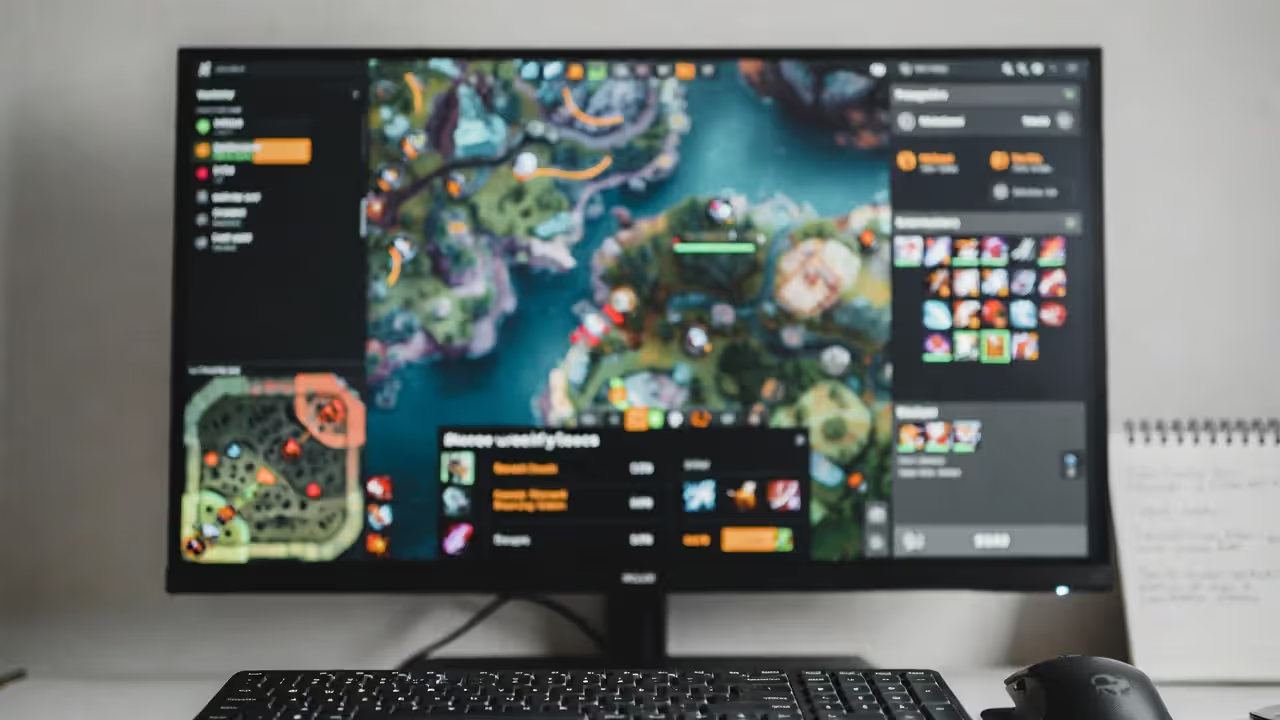
MOBAs (Multiplayer Online Battle Arenas) essentially created the modern esports blueprint. Their combination of strategic depth, team coordination requirements, and explosive team fights translates exceptionally well to competitive formats.

Author: Tyler Brooks;
Source: quantumcatanimation.com
League of Legends and Dota 2
These two titans have dominated the biggest esports games conversation for over a decade. League of Legends draws approximately 180 million monthly players and hosts the World Championship, which regularly peaks above 5 million concurrent viewers. Riot operates franchised regional leagues across North America, Europe, China, Korea, and emerging regions—creating year-round storylines rather than isolated tournaments.
Dota 2 takes a different approach. Valve's hands-off philosophy means fewer structured leagues but one massive annual event: The International. The 2023 edition featured a $3 million base prize pool that ballooned through community contributions. Dota's complexity is legendary—over 120 heroes each with four unique abilities, itemization trees that dramatically alter playstyles, and mechanics like creep denial that don't exist in League.
The skill expression differs between them. League emphasizes mechanical outplays and team fight execution. Dota rewards strategic creativity and draft phase intelligence—teams can win before the game starts through superior picks and bans. Neither approach is superior; they attract different player personalities and create distinct viewing experiences.
Author: Tyler Brooks;
Source: quantumcatanimation.com
Emerging MOBA Contenders
Mobile Legends: Bang Bang carved out massive success in Southeast Asia where mobile gaming dominates. Its simplified MOBA mechanics work perfectly on touchscreens, and regional tournaments in Indonesia, Philippines, and Malaysia draw stadium crowds. League of Legends: Wild Rift—Riot's mobile adaptation—launched to challenge this space with higher production values and cross-platform ambitions.
Honor of Kings (known as Arena of Valor internationally) dominates China's mobile market with over 100 million daily active users. Its esports scene rivals traditional PC titles in regional viewership, though it hasn't achieved the same Western recognition.
First-Person Shooters: Fast-Paced Competition at Its Peak
FPS titles offer immediate spectator appeal—point, shoot, eliminate opponent. But the genre splits into distinct competitive sub-categories, each with unique demands.
Tactical Shooters (CS2, Valorant)
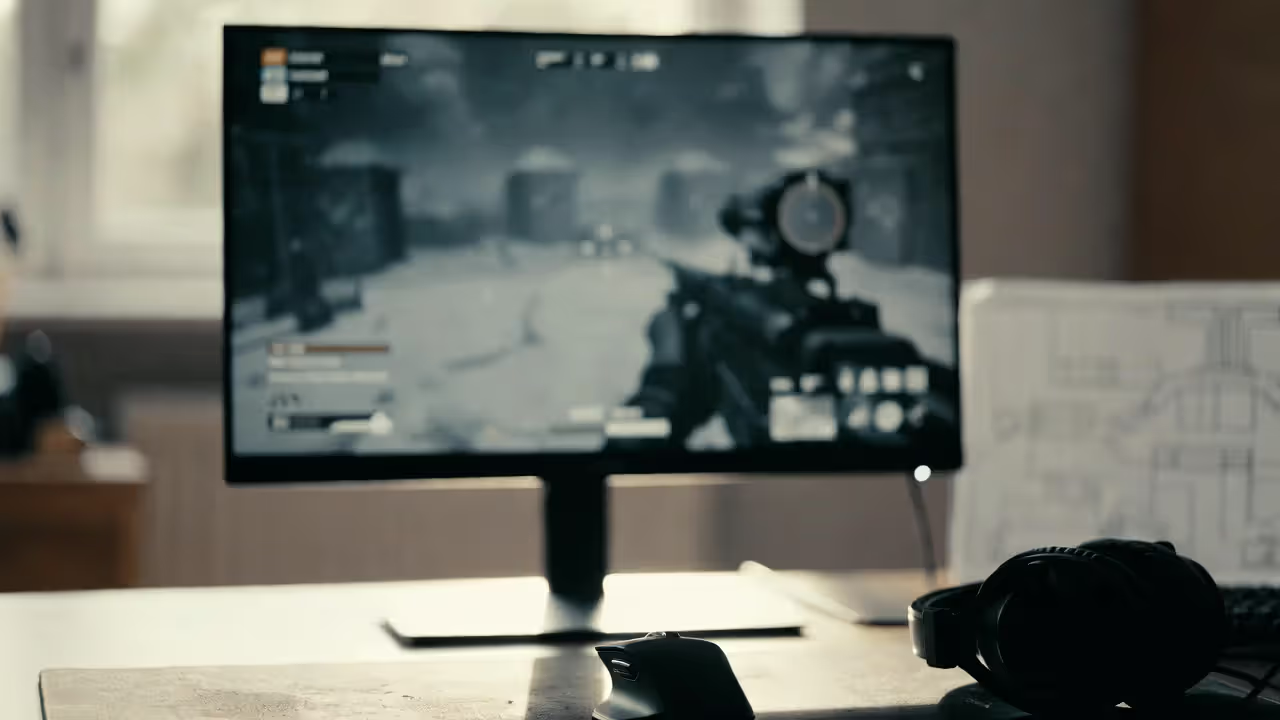
Counter-Strike 2, the latest evolution of a franchise approaching its 25th year, remains the gold standard for tactical FPS competition. Its economy system creates strategic layers beyond pure aim—teams must manage money across rounds, deciding when to buy rifles versus saving for future rounds. A single AWP sniper costs $4,750, and losing it to an enemy can swing entire matches.
The skill ceiling is brutal. Professional players practice spray patterns for specific weapons, memorize dozens of smoke grenade lineups to block sightlines, and develop game sense that lets them predict enemy positions through subtle audio cues. CS2's Major Championships, backed by Valve, distribute millions in prize money and feature the most prestigious trophies in FPS esports.
Valorant launched in 2020 as Riot's answer to Counter-Strike, blending tactical shooting with hero abilities. Each agent brings unique tools—smokes, flashes, walls, information-gathering abilities—that add strategic variety while maintaining CS-style gunplay fundamentals. The Valorant Champions Tour operates similarly to League's franchise model, with regional leagues feeding into international LANs.
The trade-off: Counter-Strike purists value its lack of abilities, arguing that raw skill determines outcomes. Valorant attracts players who enjoy strategic diversity and the ability to specialize in specific agents. Both approaches sustain healthy competitive scenes.
Author: Tyler Brooks;
Source: quantumcatanimation.com
Battle Royales (Apex Legends, PUBG)
Battle royales face unique esports challenges. How do you create spectator-friendly competition when 20+ teams spread across massive maps? PUBG, the genre pioneer, struggled with this for years before developing better observer tools and region-focused formats.
Apex Legends solved some issues through faster gameplay and smaller team sizes (3 players instead of 4). Its hero-based system—borrowed from MOBAs—creates identifiable team compositions. The Apex Legends Global Series features consistent scoring across multiple matches, rewarding placement points and eliminations to determine winners.
Fortnite carved its niche through sheer prize pool size. Epic Games distributed over $30 million in its 2019 World Cup, though viewership and competitive sustainability haven't matched those investment levels. Building mechanics create a skill gap, but randomized loot and frequent meta-shifting updates frustrate professional players seeking consistency.
Fighting Games and Sports Simulations in Competitive Play
Fighting games represent the oldest esports genre, tracing roots to arcade competitions in the 1990s. Street Fighter, Tekken, and Mortal Kombat maintain dedicated competitive communities through a unique tournament structure—the FGC (Fighting Game Community) operates more grassroots than corporate-backed leagues.
The Capcom Pro Tour for Street Fighter and Tekken World Tour create annual circuits where players earn points at local, regional, and premier events, culminating in championship finals. Prize pools are smaller than MOBAs or shooters—often $250,000-$500,000 for major events—but the community passion runs deeper. EVO (Evolution Championship Series) serves as fighting game esports' Super Bowl, featuring multiple titles over a single weekend.
Individual skill matters more here than any other genre. No teammates to rely on, no randomness to blame. When you lose, it's because your opponent outplayed you. This creates compelling narratives—decade-long rivalries, redemption arcs, underdog stories.
Sports simulations like EA Sports FC (formerly FIFA) and NBA 2K occupy a unique space. They simulate real sports, attracting fans who follow both traditional athletics and competitive gaming. FC's esports scene centers around Ultimate Team mode, where players build squads from card packs—a model that generates revenue but raises pay-to-win concerns in competitive contexts.
Rocket League defies easy categorization. It's technically a sports game (soccer with cars), but plays like a physics-based competitive multiplayer game requiring precise aerial control and team coordination. Its esports scene has grown steadily, with the RLCS (Rocket League Championship Series) featuring consistent seasonal competition and production quality rivaling traditional sports broadcasts.
Mobile Esports: The Fastest-Growing Competitive Gaming Sector
Mobile gaming accounts for over half of global gaming revenue, and competitive scenes are catching up. The accessibility factor cannot be overstated—billions of people own smartphones capable of running competitive titles, while gaming PCs remain expensive barriers to entry.
PUBG Mobile dominates in India (despite periodic bans) and South Asia, with the PMGC (PUBG Mobile Global Championship) distributing multi-million dollar prize pools. Free Fire, developed by Garena, captured Latin American and Southeast Asian markets through lower hardware requirements—it runs on budget Android devices that can't handle PUBG Mobile.
These titles modify PC game formulas for touchscreen controls, typically simplifying mechanics while maintaining core competitive elements. Aim assist helps compensate for imprecise touch controls, and matches often feature more players than PC equivalents to account for mobile sessions' shorter average duration.
Regional popularity varies dramatically. While mobile esports struggles for legitimacy in North America and Europe, Southeast Asian and Latin American tournaments fill stadiums. Prize pools increasingly rival PC titles in these regions, and professional mobile gamers earn salaries comparable to traditional esports athletes.

Author: Tyler Brooks;
Source: quantumcatanimation.com
The stigma persists among PC and console players who view mobile as "casual," but viewership numbers tell a different story. Mobile esports events regularly pull millions of concurrent viewers, particularly in regions where mobile-first gaming is the norm rather than exception.
How Prize Pools and Viewership Define the Biggest Esports Games
Commercial success metrics reveal which titles truly dominate competitive gaming. Prize pools indicate developer and community investment, while viewership demonstrates spectator appeal and cultural relevance.
| Game Title | 2023-2024 Total Prize Pool | Peak Tournament Viewers | Est. Active Competitive Players | Primary Platform |
| Dota 2 | $40+ million | 5.5 million | 600,000+ | PC |
| League of Legends | $10+ million | 6.4 million | 2+ million | PC |
| Counter-Strike 2 | $15+ million | 2.7 million | 1+ million | PC |
| Valorant | $8+ million | 1.5 million | 800,000+ | PC |
| PUBG Mobile | $12+ million | 3.8 million | 1.5+ million | Mobile |
| Fortnite | $10+ million | 1.2 million | 500,000+ | Multi-platform |
| Apex Legends | $5+ million | 500,000 | 300,000+ | Multi-platform |
| Rocket League | $6+ million | 400,000 | 250,000+ | Multi-platform |
| Street Fighter 6 | $2+ million | 300,000 | 150,000+ | Multi-platform |
| EA Sports FC 24 | $3+ million | 250,000 | 400,000+ | Multi-platform |
These numbers reveal interesting patterns. Dota 2's prize pools dwarf competitors thanks to The International's crowdfunding model, but League of Legends matches or exceeds it in viewership. Counter-Strike 2 maintains consistent numbers across both metrics, demonstrating balanced ecosystem health.
Mobile titles like PUBG Mobile show that platform doesn't determine success—viewership and prize pools compete directly with PC games. Meanwhile, fighting games and sports sims command smaller but dedicated audiences, proving that esports success doesn't require MOBA-scale numbers.
Twitch and YouTube Gaming viewership extends beyond major tournaments. League of Legends consistently ranks among the top three most-watched games on Twitch, with professional matches, streamers, and content creators maintaining year-round engagement. This sustained interest between tournaments matters more for long-term viability than single-event peaks.
Common Mistakes When Choosing an Esports Game to Follow or Play Competitively
Picking a competitive title based purely on current hype leads to disappointment when that hype fades. Remember Overwatch's explosive launch? Blizzard invested heavily in the Overwatch League with franchised city-based teams, but viewership declined steadily, and by 2023, the league effectively shut down. Early adopters who committed to competitive Overwatch faced an uncertain future.
Ignoring regional availability causes frustration. Some games thrive in specific regions while barely existing elsewhere. Mobile Legends is massive in Southeast Asia but nearly absent in North America. Trying to compete in a game without local tournaments, practice partners, or community support makes progression exponentially harder.
Underestimating time investment is perhaps the most common error. Reaching competitive viability in any esport requires thousands of hours. League of Legends players need to understand 160+ champions, countless matchups, macro strategy, and team coordination. Counter-Strike demands muscle memory development for spray patterns, grenade lineups, and map knowledge across seven active duty maps. Casual play won't cut it—competitive improvement requires deliberate practice.
Not considering game longevity before committing creates problems. New titles launch with esports ambitions regularly, but most fail within two years. Before investing serious time, examine developer commitment: Is there a multi-year roadmap? Consistent updates? Growing or shrinking player bases? Established tournament infrastructure or vague promises?
Choosing based on viewing enjoyment rather than playing enjoyment seems obvious but happens constantly. Counter-Strike is thrilling to watch, but if you don't enjoy tactical, methodical FPS gameplay, you'll burn out quickly. Fighting games create incredible tournament moments, but the solo grind and execution barriers frustrate players expecting team-based experiences.
Overlooking hardware requirements affects both performance and budget. Competitive PC gaming demands high refresh rate monitors (144Hz minimum for serious play), gaming mice with precise sensors, mechanical keyboards, and capable PCs maintaining consistent framerates. Console esports reduce this barrier, but competitive console scenes exist for fewer titles.
FAQ: Your Questions About Competitive Gaming Titles Answered
The competitive gaming landscape in 2024 features remarkable diversity—from mobile titles filling Southeast Asian stadiums to tactical shooters maintaining decades-long competitive legacies. The esports games list continues evolving, but patterns emerge: successful competitive titles combine spectator appeal with deep skill expression, backed by developer commitment to long-term ecosystem development.
Whether you're drawn to the strategic depth of MOBAs, the precision of tactical shooters, the individual skill expression of fighting games, or the accessibility of mobile competition, understanding what makes these games succeed competitively helps you make informed choices about which scenes to follow or join.
The games that dominate prize pools and viewership earned those positions through years of refinement, community building, and sustained investment. New titles will emerge, but the fundamentals remain constant—competitive gaming rewards titles that are equally compelling to play and watch, with skill ceilings high enough that professionals can build careers demonstrating mastery.